The Tree That Wasn’t Finished
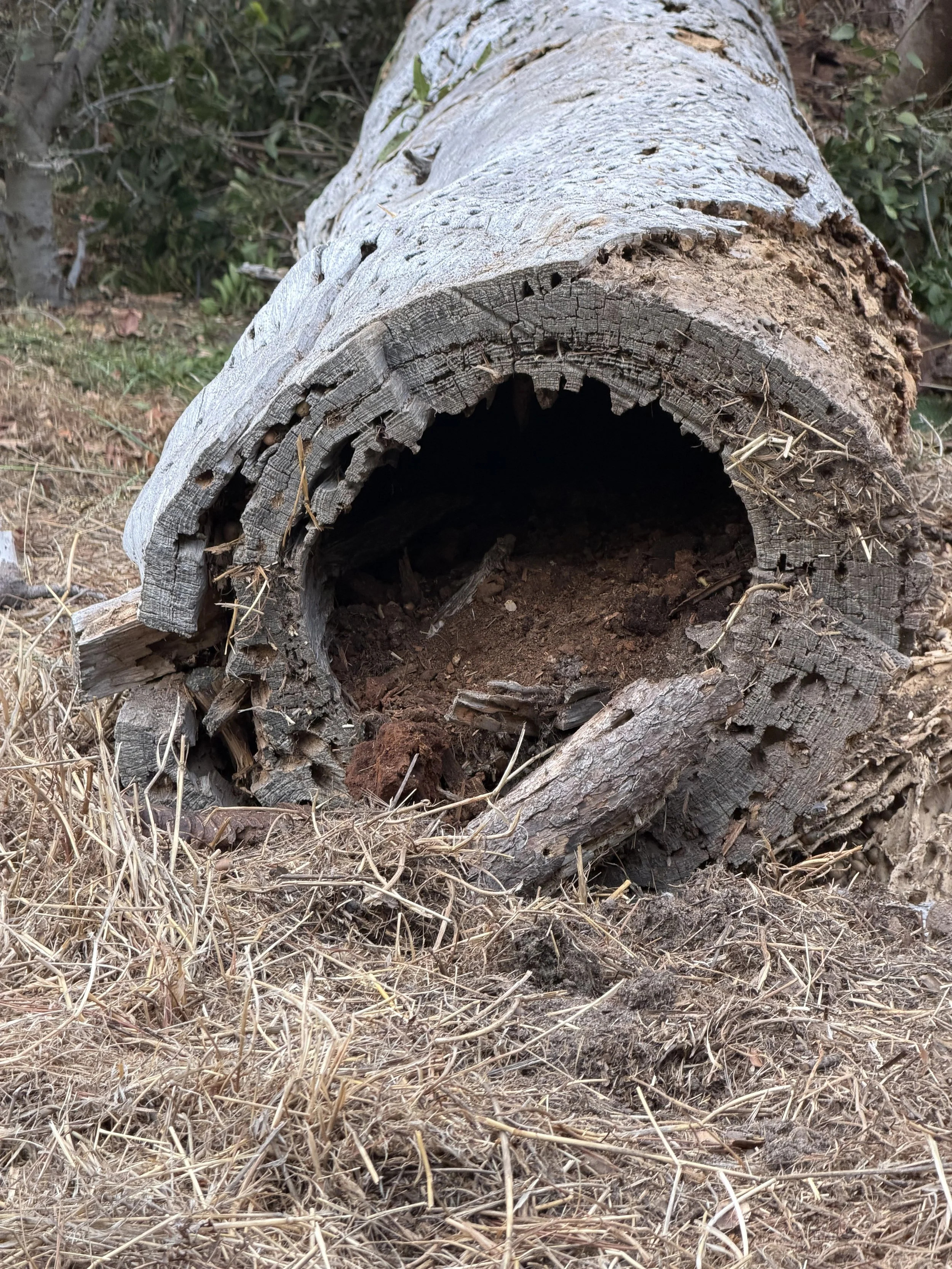
A rare view into the raccoon den
There was a tree just beyond my house that did not belong to me. It stood in a small city green space, perhaps sixty or seventy feet tall—or at least it felt that tall from where I sat on my porch.
By most definitions, the tree was dead. It had no leafy crown. No spreading canopy. Its top was gone. What remained was one long, weathered trunk, with a branch reaching out somewhere near the middle. It wasn’t the kind of tree most people would stop to photograph. But I did. I took pictures of it. I took videos. I watched it almost every day.
There was a little face in the wood, created by a water stain or the natural knots in the trunk. Some days it reminded me of our dog, Winnie. Other days, I saw a little bear looking back at me. And the tree was covered in woodpecker holes. From my porch, I would watch the woodpeckers arrive and go to work. Other birds made homes near the broken top or simply used the tree as a place to land—to rest, to look out, to begin again.
Then there were the raccoons.
A mother raccoon gave birth high inside that tree. I watched her raise her babies there, tucked safely inside something that appeared, from the outside, to have no life left in it. When it was time to leave, she carried them down one by one. At one point, she fell from high in the tree. Somehow, she gathered herself and climbed all the way back up. I watched it all from my porch.
The tree became its own little world—a nursery, a shelter, a workshop, a lookout and a gathering place. It was dead. But it was not empty. It was not useless. And it was not finished.
The tree often made me think of one of my favorite childhood books, Shel Silverstein’s The Giving Tree. But this tree gave in a different way. It had no apples left to offer. No shade beneath a lush canopy. It gave what it still had: its height, its hollows, its scars, its steadiness.
It gave the woodpeckers something to work on. It gave the birds a place to land. It gave a mother a safe place to bring new life into the world. And it gave me something too—a place to rest my eyes, a reason to look up and a small, living story to witness from my porch.
Yesterday, I came home after spending time with my son in Yosemite. I felt almost overwhelmed by the beauty of it all—the granite cliffs, the immense trees, the scale of a landscape so magnificent it almost doesn’t seem real.
I drove home late, still carrying that beauty with me. And when I pulled up, I noticed that my tree was gone. It had been cut down. I don’t know why. Perhaps it had become unsafe. Perhaps it was simply time. It wasn’t my tree, and the decision wasn’t mine to make.
Still, I felt sad.
As I stood near what remained, I could hear a louder-than-usual buzzing coming from it—perhaps crickets or insects still moving somewhere inside the wood. Even then, after it had fallen, the tree seemed to be holding life.
And I realized something: We can grieve what was never ours to keep. The tree didn’t belong to me. But I had formed a relationship with it. I had paid attention to it. It had become part of the landscape of my days. I also found myself wondering how often we confuse no longer what it once was with no longer valuable.
We are quick to admire what is thriving in obvious ways—the tree in full bloom, the soaring mountain, the person at the height of strength or success. But there are other kinds of beauty. There is beauty in continuing to offer what remains. There is purpose that doesn’t look polished or impressive.
There is life taking shelter inside places we might have mistaken for finished.
That old tree had lost its branches, its leaves and even its top. But it was still serving the world around it. Not by pretending to be what it had once been, but by offering exactly what it was now.
Maybe that is what I want to carry with me from the tree that wasn’t finished: Our usefulness does not end when we change. Our beauty does not disappear when we no longer look the way we once did. And sometimes, what appears to be an ending is quietly making room for another life to begin.
The tree never belonged to me. But I will miss it. And I will always be grateful that, for a little while, I knew to look up.
